TORONTO - Rogers Communications Inc. (TSX:RCI.B) more than doubled its first-quarter profits but news that its wireless division will soon carry the Apple iPhone stole the limelight from stronger results across its services.
While it had been widely expected that the high-tech, touch-screen phone would become available on the Rogers network, Tuesday's announcement was the first official confirmation. However, executives declined to reveal exactly when the device would become available, saying only that it would be later this year.
Coupled with strong quarterly earnings, the announcement helped Rogers stock end the session ahead 3.6 per cent, up $1.56 to $44.46, at the Toronto Stock Exchange.
Rogers reported net earnings of $344 million or 54 cents per share on a diluted basis, compared with a profit of $170 million, 26 cents per share in the year-earlier period.
That was well above an average analyst forecast for earnings of 43 cents per share in the period, according to Thomson Financial.
Company president and chief executive Ted Rogers said in a conference call that the quarter reflected "the benefits of how we're increasingly operating as a single company."
But there were also signs the company could be bracing for trouble in the coming quarters, especially as the economy slows.
Ted Rogers told investors that the media giant will continue to focus on strengthening its existing business rather than pursuing large acquisitions in the foreseeable future.
"We must continue to demonstrate constraint on the cost side to protect ourselves from the economic downturn which seems to be spreading outside the U.S.," he told investors.
He added that the company is already experiencing some signs of slowing in Ontario.
That raises the question whether Canadians who are caught up in an economic slowdown will be willing to shell out money for a high-priced vanity phone.
While Rogers declined to reveal its pricing plans, the iPhone hardware sells in two different tiers in the United States - an eight gigabyte model goes for US$399 and a 16 gigabyte model is valued at US$499.
Package deals with carriers tend to reduce the price of phones when customers are signed to a contract agreement.
"It's not a purchase you make if you're watching your budget - it's an object of desire and a hot technology product," said Kaan Yigit, an analyst at Solutions Research Group.
But "the main benefit (for Rogers) is beyond the subscriber signups. It's image and its watercooler talk and all those kinds of things."
The iPhone caused a sensation last summer when U.S. customers lined up outside Apple stores to be one of the first to get their hands on the product.
The phone integrates the concept of Apple's popular iPod MP3 and video player with the capability of a mobile phone, Internet browser and other multimedia features.
While the iPhone has been available in the United States for nearly a year and in Europe for several months but there's been a delay in bringing it to Canada, where Rogers currently has the only GSM networks capable of handling Apple's first phone.
Rogers had been officially noncommittal about the iPhone but there have been reports that a big stumbling block to its entry was the pricing of the data services required to take advantage of the iPhone's music and video features.
In a media conference before the company's annual meeting Ted Rogers denied that data rates were an anchor on striking a deal with Apple.
"We were a little slow in the negotiating is all I can say," he told reporters.
Executives declined to discuss the iPhone plans, pricing or the timeline for its rollout, saying that they had obligations to keep quiet as part of a contract.
However, the confirmation from executives was the first time they'd officially acknowledged that a deal had been stuck with Apple - even though the Canadian mobile phone industry had widely expected Rogers to carry the phone.
Analysts widely greeted the iPhone announcement with a positive response.
"Our analysis shows the iPhone could be an important catalyst for the shares: it could add an extra 150,000 net (subscriber) adds for Rogers, or $100 million in annual EBITDA," wrote Jonathan Allen, an analyst at RBC Capital Markets.
"The market will have to wait to see whether Rogers launches the current model or waits for the 3G (third-generation model) - expected to be released by Apple in July."
Rogers said its revenue grew 14 per cent to $2.6 billion, while the key wireless division saw postpaid net subscriber additions grow to 97,000 for the period.
Operating revenue at the wireless segment for the period ended March 31 was $1.43 billion, up 16 per cent from $1.23 billion in the prior-year period.
The company's cable segment - which includes Internet and home phone services - posted an eight per cent rise in operating revenue to $925 million from $855 million.
In its media division, revenue climbed 15 per cent to $307 million over the same period last year, partly helped by the acquisition of the Citytv assets last October - part of CTV divesting some of the assets acquired in the acquisition of CHUM.
But Citytv could endure some new challenges before the new television season begins in the fall, said Tony Viner, president of Rogers Media Inc.
"Because of the writer's strike there's going to be fewer new programs available in Hollywood," he said in a media conference.
"We are going to be a significant competitor in program acquisition and operations, but compared to CanWest and CTV we're significantly smaller."
A spokeswoman for Rogers said the company plans to keep the Citytv name, and not link Rogers directly to the branding of the stations.


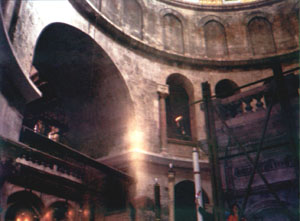
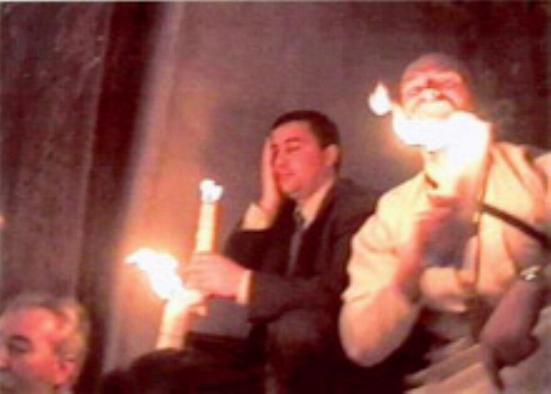 his divine light also presents some peculiarities: As soon as it appears it has a bluish hue and does not burn. At the first moments of its appearance, if it touches the face, or the mouth, or the hands, it does not burn. This is proof of its divine and supernatural origin. We must also take into consideration that the Holy Light appears only by the invocation of an Orthodox Archbishop.[1]
 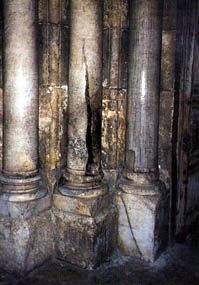 Every time heterodox have tried to obtain the Holy Fire they have failed. Three such attempts are known. Two occured in the twelfth century when priests of the Roman church tried to force out the Orthodox church but by their own confession these ended with God's punishment. [3,4] But the most miraculous event occured in the year 1579, the year when God clearly testified to whom alone may be given His miracle.
 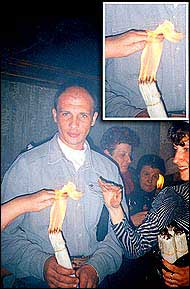 As with any other miracle there are people who believe it is a fraud and nothing but a masterpiece of Orthodox propaganda. They believe the Patriarch has a lighter inside of the tomb. These critics, however, are confronted with a number of problems. Matches and other means of ignition are recent inventions. Only a few hundred years ago lighting a fire was an undertaking that lasted much longer than the few minutes during which the Patriarch is inside the tomb. One then could perhaps say, he had an oil lamp burning inside, from which he kindled the candles, but the local authorities confirmed that they had checked the tomb and found no light inside it.
 The night of Sunday is the culmination of the Easter celebration, with the midnight service, the procession around the church with burning candles, and the joyous Morning Prayer and Communion service bringing people together in a spiritual joy. Priests change their black vestments to white ones; eggs, pashka and kulich are blessed, and Great Lent is over.
 Monday and Tuesday: ‘Bathing’; Water is poured over those who overslept the morning service.
 The egg occupies a central place in the Orthodox Easter holiday. The egg that has been blessed in the church is the first thing to be eaten after the Easter service. People exchanged eggs, presented them to relatives, friends and neighbours, and families brought eggs to the graves of descendents, and shared eggs with poor people.
  Since the reign of Tsar Alexei Mikhailovich in the early 17th Century it was traditional for the Tsar to give out eggs as presents (Tsar Alexei gave out some thirty-seven thousand). The Imperial Porcelain Factory began to make Easter eggs in 1748, and they became so popular that the number produced annually reached 15,365 pieces in 1916. These eggs were the most expensive: it took forty days to paint one egg, and cost 75 roubles, which was a large sum of money.
  The easiest and most common way to paint eggs is to boil them together with onion husks. Just put the husks in cold water, clean the eggs and boil for 10 minutes. When the eggs are ready, wipe them dry and then rub until they shine with a cloth soaked in vegetable oil. You can then paint them as you wish.
 Dissolve the yeast in a glass of cream, add half of the flour and put the mixture aside in a warm place. When the brew rises, add egg yolks grated with butter and sugar, the rest of the flour, cream, cardamom, nutmeg, almonds, finely-cut candied peels and washed and dried raisins. Beat the dough well and put it aside in a warm place for 1.5 to 2 hours. Mix the dough again and put it in a tall form washed over with butter and sprinkled with grounded bread crusts. Fill the form to half it’s volume and let the dough rise again until it reaches half of the form’s length, then put in the oven on a medium fire.


